
https://www.youtube.com/watch?v=mfYQgiu-4CU
I’ve always believed you learn more from a camera when you put it somewhere it doesn’t belong. Which is how I ended up at a thumping Cooks concert in Cardiff – my Leica MEV1 in hand and, if I’m honest, a touch of anxiety in my stomach. Not only was I stepping away from the safety net of autofocus, but I was also introducing a manual focus, 60-megapixel full-frame behemoth to one of the least-forgiving photo environments imaginable. What followed? A delightful, unpredictable mess. Here’s how the MEV1 charmed (and challenged) me, and why I think this isn’t just another Leica for collectors, but a rebellious tool for creative mischief.
You may be interested

1. Into the Wild: Taking the Leica MEV1 Out of Its Element
Why would anyone drag a Leica MEV1 to a live gig instead of a safe, modern shooter? That’s the question I asked myself as I packed my bag for the Cooks at the Utility Arena in Cardiff. Most would reach for a Sony A1 or a Canon R5—autofocus beasts built for chaos. But I wanted to see what happened when you break the rules. The Leica MEV1 camera is not your typical choice for concert photography performance, but that’s exactly why I brought it.
“So, what do you get when you combine a Leica Q and a Leica M and mix it all together? Well, you get this camera, the MEV1. It’s what you’d expect out of Leica: premium engineering, simplistic design, and pretty easy to use.” That’s the theory, at least. In practice, the MEV1’s manual focus and M mount lenses are a far cry from the comfort of point-and-shoot.
As I stepped into the pulsing crowd, my heart rate shot up and my expectations dropped. The 60MP full-frame sensor promised detail, but low light, unpredictable strobes, and constant movement threatened to undo me. I started with the 21mm Voigtländer for wide crowd shots, swapped to the 135mm Leica for distant stage moments, then the 90mm f/2.5 Leica and 50mm f/1.4 close focus for portraits and atmosphere. Swapping lenses mid-show was both exhilarating and nerve-wracking—one slip and I’d be crawling underfoot for a precious M mount cap.
Manual focus at a gig is, frankly, bonkers. Every time the lights changed, I had to refocus, fighting muscle memory that screamed for autofocus. Still, when I nailed it, the results were magic: crisp, characterful, and unmistakably Leica. The Leica MEV1 review I’d read warned me it wasn’t built for this, but mastering manual focus in the wild is oddly addictive.
Did anyone notice my odd choice of kit? Not really—except for the one bloke who leaned over and said, “Nice lens, mate.” That tiny moment of recognition was enough to keep my spirits up. I’ll admit, I have a nervous habit of stress-tapping the lens release button mid-show, just to be sure it’s locked in. It’s a silly ritual, but it kept me grounded as I pushed the MEV1 far beyond its comfort zone.
2. Anatomy of a Maverick: MEV1 Specs & Features that Surprised Me
If you think you know Leica, the MEV1 will have you questioning everything. This camera is a curious blend of tradition and innovation, and my time road-testing it in the chaos of a concert revealed quirks and delights I never expected. Let’s break down the Leica MEV1 features and what truly sets this camera apart.
60MP Sensor: Pixel-Mad or Overkill?
The headline spec is the 60 megapixel full-frame sensor. At first, I wondered if this was pixel overkill, especially for low-light gigs. But as I shot, I found it “pretty good, reasonably in low light. I mean, it’s going to be a little bit noisy the photos. It’s going to be interesting to see how they actually come out.” The detail is staggering, and while noise creeps in at higher ISOs, the files hold up surprisingly well for concert photography.
Rangefinder Soul with Digital Muscle
Leica’s rangefinder DNA is alive and well, but the MEV1’s digital viewfinder is a genuine game-changer. In the dim, unpredictable lighting of a gig, the clarity and real-time feedback were a lifesaver—something classic M bodies simply can’t match. It’s the best of both worlds: tactile, manual focus with the safety net of digital precision. That said, the hybrid approach isn’t perfect. The menu system is, frankly, baffling at times. Who designed that back button? It’s a small but persistent frustration.
Native M Mount: Vintage Meets Modern
The MEV1’s native M mount means you can pair it with anything from vintage glass to the latest Leica optics. This opens up a world of creative possibilities, but also a few risks—older lenses can be unpredictable on a 60MP sensor, revealing every flaw and quirk. Still, the character they bring is pure Leica magic.
Build Quality and Battery Innovation
The unibody design is as robust as you’d expect at this price point (around £7,000 body-only). What really surprised me was the battery system: no door, just a slick, quick-swap mechanism. “You just click out the batteries by untapping them and then just click them back in and they all come out.” It’s fast, satisfying, and keeps you shooting. Oddly, there’s a lack of full weather sealing—a strange omission for a camera built for the field.
| Feature | Details |
|---|---|
| Sensor | 60 megapixel full-frame |
| Lens Mount | Native M mount |
| Body Price | Approx. £7,000 |
| Battery | Quick-swap, no door |
The Leica MEV1 camera is a maverick—equal parts nostalgia and cutting-edge, with a few surprises (and frustrations) thrown in for good measure.
3. When Precision Counts: Shooting in Concert Chaos (Data Table)
There’s nothing quite like the chaos of a live gig to test a camera’s mettle. The Leica MEV1, with its manual focus lens, was never designed for the sweat and swirl of a Cardiff concert, but that’s exactly where I found myself—elbows deep in the crowd, swapping between a 21mm, 50mm, 90mm, and 135mm, and praying my timing was as sharp as my focus. Here’s where the Leica MEV1 concert performance truly got interesting.
Frame Rate Reality Check
Let’s be honest: four frames per second is not what you’d call rapid fire. At a gig, where the action is unpredictable and the lights are ever-changing, this meant every shot had to count. There’s no spray-and-pray here—each frame is a deliberate act. Compared to the Sony A1’s blistering speed, the MEV1 feels almost meditative.
Manual Focus Drama
Manual focus in concert photography performance is a double-edged sword. I missed more than a few moments—no surprise there. But the shots I did nail had a unique character, that unmistakable Leica look: rich contrast, punchy colours, and a sense of presence you don’t always get with clinical autofocus perfection. As I muttered to myself,
“I’d rather have the autofocus. I’d rather have a camera that’s really designed for it. But something I didn’t expect when using this is that Leica characteristic to really shine above everything else.”
Autofocus Absence: Coping Strategies
Without tracking autofocus, I had to anticipate the action, pre-focus, and hope the band didn’t leap out of my chosen plane. It was stressful, yes, but also exhilarating—like shooting on a tightrope. The Sony A1 would have delivered more keepers, but the MEV1’s hits felt more hard-won and, dare I say, more artistic.
Noise Trade-Offs & Unexpected Wins
Pushing the ISO was inevitable. The 60MP full-frame sensor handled low light reasonably well, though noise crept in at higher settings. Still, the images retained that Leica contrast and colour, even when technically ‘wrong’. Some of my favourite frames were the ones that shouldn’t have worked, but did—grain and all.
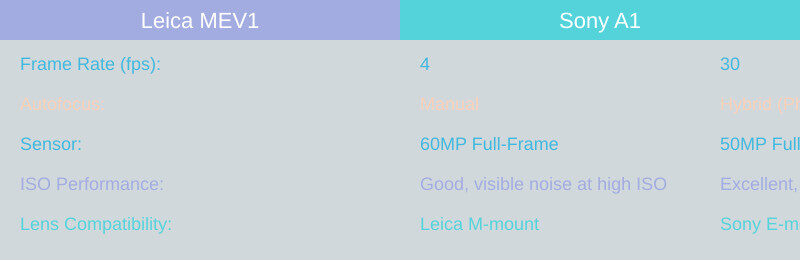
The data table above lays it bare: the Leica MEV1 is outgunned by the Sony A1 in speed and autofocus, but it brings a unique, deliberate artistry to concert photography performance. Sometimes, the shots you fight for are the ones you remember most.
4. Mastering Low Light: Leica MEV1’s Dance with Darkness (Chart)
Let’s be honest—most people don’t reach for a Leica MEV1 when heading into a dark, chaotic concert pit. But that’s exactly why I did. I wanted to see how the Leica MEV1 low light performance would hold up when pushed far outside its supposed comfort zone. The result? “For a camera that’s not really best suited for this situation… the photos came out really quite nice.”
Reality-Check: Numbers & Feel
Armed with the 60MP sensor and a f/2.5 90mm lens, I cranked the ISO up to 3200 and even 6400 at times—territory where many sensors start to sweat. The MEV1 didn’t shy away, but it did show its character: visible grain, yes, but a grain that felt almost filmic, not clinical. The image sharpness and contrast survived surprisingly well, even when the light was little more than a dim wash from the stage.
Megapixels at Midnight: Blessing or Burden?
Here’s the thing: 60 megapixels means you can crop in post to your heart’s content. But in low light, that resolution is a double-edged sword. You get flexibility, but every pixel is a potential canvas for noise. I found that as long as I didn’t push the files too far, the detail was there—just don’t expect perfection at 100% zoom.
Noisy by Nature: ISO and the Art of Letting Go
| ISO | Noise Level | Sharpness | Contrast |
|---|---|---|---|
| 1600 | Low | Excellent | Strong |
| 3200 | Moderate | Very Good | Good |
| 6400 | Noticeable | Fair | Acceptable |
At ISO 3200, the MEV1 walks the line: grain is present but not distracting. At 6400, it’s obvious, but sometimes that’s the price of catching the moment.
Digital Viewfinder: Seeing in the Dark
The digital viewfinder was a lifesaver. In the thick of the crowd, when my own eyes struggled, the EVF let me compose and focus with surprising confidence. Manual focus is a challenge, especially in low light, but it forced me to slow down and hunt for the decisive moment—a classic rangefinder experience.
Anecdote: The Happy Accident
One of my favourite shots from the night was nearly binned. It was a little soft, a little grainy, but the mood was all there—proof that sometimes, technical imperfection is exactly what you need.
5. Sweet on the Streets: MEV1 Beyond the Concert Pit
After the chaos of the concert pit, taking the Leica MEV1 out onto the streets felt like letting the camera breathe in its natural element. As I wandered through city lanes, it became clear: Leica MEV1 street photography isn’t just a use case—it’s the camera’s calling. The MEV1’s design and ergonomics are a hit for street photographers, especially those who love to slow down and frame deliberately. There’s a certain romance to the way it sits in your hands, encouraging you to observe, wait, and then capture that perfect, fleeting moment.
Manual Focus: Meditation in Motion
One of the joys of the MEV1 is its manual focus experience. On the street, this becomes almost meditative—until, of course, a dog barrels into your frame and you’re forced to react on instinct. But that’s the beauty of it: the slower pace of street photography lets you savour the process. Unlike the frantic, split-second decisions required in a concert, here you can take your time, focus with intention, and truly engage with your surroundings.
Street vs Concert: Mindset Shift
The difference in mindset between street and concert work is striking. In the pit, it’s all about speed and anticipation—snapping away, hoping to catch that one epic leap or dramatic spotlight. On the street, the MEV1 encourages you to slow down, observe, and compose. As I said to a fellow shooter,
“Street photography is probably what this is more orientated to. But I like put cameras through situations in which they’re not suited just for the fun of it, really.”
Lens Compatibility: Swapping Glass in Public
Switching between lenses on the street—like the 23mm (35mm equivalent) and 21mm—felt less pressured than in a gig. It’s almost fun, even when you get the odd stare from a passerby. Swapping vintage glass in public can spark curiosity and the occasional conversation, adding a social element to your shooting. The MEV1’s lens compatibility means you’re never short of creative options, whether you want to go wide for cityscapes or tighter for candid portraits.
MEV1: Slowing Down, Seeing More
Ultimately, the MEV1’s street photography capabilities shine brightest when you let it slow you down. The camera’s classic roots and tactile controls make every shot feel intentional. In a world obsessed with speed, the MEV1 reminds you that sometimes, the best images come to those who wait.
6. The Quirks that Stick: Build, Feel, & the Leica Effect
Let’s talk about the build quality and design of the Leica MEV1, because honestly, this is where the magic begins. Leica’s reputation for precision German engineering is legendary, and the MEV1 doesn’t disappoint. The unibody construction feels like it’s been carved from a single block of metal—sturdy, tactile, and classic to the core. It’s the sort of camera you want to pick up, hold, and never put down. There’s a certain weight and balance to it that just screams quality, and every dial and button has that satisfying, deliberate resistance. As one fellow enthusiast put it,
“They just are the main camera brand and they’ve got that precision German engineering that you can get in other cameras but nothing quite the same as what it is to have it like.”
Battery Swaps: No Door, No Fuss
One of my favourite camera design features on the MEV1 is the battery system. There’s no fiddly battery door here—instead, you simply click the battery out and pop a new one in. It’s so slick, I found myself swapping batteries just for the fun of it. Not only is it practical, but it’s also a design quirk that sets the Leica MEV1 build and design apart from the crowd. It’s still sealed well enough for daily use, but don’t expect full weather-sealing.
Weather-Sealing: The Drama
Now, about that weather-sealing. The MEV1 isn’t fully weather-sealed, which might make you pause if you’re planning to shoot in the pouring rain at Glastonbury. Leica has kept things classic, focusing on compatibility with legacy lenses—so, it’s not quite the ‘take-anywhere’ rangefinder camera. For me, it’s a fair trade-off, given the heritage and flexibility you get with Leica M lenses.
The Red Dot & The Leica Effect
Let’s not ignore the social side. That little red dot on the front? It’s a conversation starter, a badge of honour, and sometimes, a magnet for envy. There’s a mystique to Leica ownership that’s hard to quantify. The ‘Leica look’—that elusive blend of sharpness, micro-contrast, and creamy bokeh—is as much about how the camera feels as what it produces. Some say it’s mythic, others swear by it. Either way, it’s real enough to keep people coming back, even at £7,000 for the body only.
Does It Make You Better?
Here’s the mythbuster: owning a Leica won’t magically make you a better photographer. But the tactile joy, the history, and the Leica M sensor experience? That’s what you’re really buying into—and for many, that’s worth every penny.
7. Wild Card Wisdom: What I’d Do Differently Next Time
Mixing It Up: Control, Chaos, and the Backup Body
First lesson learned: never underestimate the value of a backup body. For my concert escapade, I didn’t just rely on the Leica MEV1—I slipped the trusty XC5 with its 23mm f/2.8 (a handy 35mm equivalent) into my pocket. That little move saved my skin when the action got unpredictable. Next time, I’d double down on this approach, perhaps even swapping in the Sony A1 for those moments when autofocus speed and frame rate are non-negotiable. The Leica MEV1 vs Sony A1 autofocus debate is real: the A1 is a speed demon, but the Leica’s charm is in its deliberate pace and tactile feel.
Dream Lens Combos: The Ones That Got Away
Let’s talk lens options—because in live music, your choice can make or break the shot. Leica MEV1 lens options are legendary, but I found myself longing for a few classics I’d left behind. The 35mm Summilux for those atmospheric wide shots, the 75mm Summicron for intimate portraits, and, of course, the mythical ‘Bokeh King’ 35mm APO. Brett at Camera Center UK raved about its crazy close focus for such a tiny lens. But, as fate would have it, I needed reach, so the 135mm ended up being the hero of the night. Sometimes, you have to trade bokeh for a longer lens—control for chaos.
When to Grab the Sony A1 (and When Not To)
There’s a time and place for every camera. The Sony A1 is the obvious pick when you need rapid autofocus and a faster frame rate. As I mused mid-gig:
“If I had a camera that actually shot at a faster frame rate, then that may have been ideal ‘cause this is just four frames a second. But overall, it performed really well.”
But honestly, the Leica’s slower pace forced me to anticipate moments, not just spray and pray. Embracing imperfection and unpredictability often leads to standout shots.
If Leica Called: My MEV2 Wishlist
- Quicker autofocus—just a touch more snappiness for those fleeting moments.
- Higher frame rate (please, Leica gods!).
- Customisable buttons for on-the-fly adjustments.
Would I shoot my dream artist with the MEV1? Maybe. But only if I could pack my fantasy lens kit and a backup body. Kit choice is fluid—what matters is knowing when to stick, and when to twist. Sometimes, embracing a camera’s limitations is the secret to unforgettable images.
8. Conclusion: Leica MEV1 – Not Quite What the Manual Promised (And That’s the Point)
After a whirlwind night road-testing the Leica MEV1 in the chaos of a live concert, I can say this: the Leica MEV1 user experience is both maddening and marvellous in equal measure. It’s not the camera you reach for when you want everything to work seamlessly, nor is it the obvious choice for fast-paced, unpredictable environments. But that’s precisely what makes it so special. The MEV1 demands adaptability, patience, and a willingness to step outside your comfort zone – and if you do, it rewards you with images and moments you simply can’t get from anything else.
The manual might promise a certain kind of precision, but in reality, the MEV1 is all about embracing imperfection and unpredictability. Would I try it again?
“Hands down. It was a wonderful experience and perhaps one of my favourite experiences I’ve had with a camera in such a position.”
There’s a tactile joy to its controls, a clarity to its rangefinder experience, and a sense that you’re part of a century-old tradition of photographers who value thought and composition over automation. The 60-megapixel sensor is a technical marvel, but it’s the feel of the images – that classic Leica look – that lingers long after the gig is over.
The Leica MEV1 isn’t for everyone, and it’s certainly not the tool for every job. But for those in search of adventure and a particular artistic vision, it makes magic happen. Leica’s quirks spark strong opinions, but they also produce surprisingly strong images. There’s beauty in pushing a camera outside its so-called ‘zone’, and the MEV1 proves that sometimes, the best camera for you is the one you least expect. It’s a lesson for any photographer: take the risky shot, embrace odd gear, and don’t be afraid to challenge your own habits.
In the end, the Leica MEV1 user experience is about more than just functionality – it’s about connection, creativity, and the thrill of making something unique. If you’re willing to meet it halfway, the MEV1 will meet you with unforgettable images and an experience that’s as rewarding as it is unpredictable. So, is it the most perfect camera in the world? No. But does it allow you to focus on the perfection that matters – your vision, your timing, your story? Absolutely. And that, for me, is the real magic of Leica.
TL;DR: The Leica MEV1 isn’t perfect for concerts—but it nails that special Leica vibe everywhere, turning even the most chaotic gigs into an adventure worth remembering. If you can embrace its quirks and lean into manual focus, you might just fall for it too.


